




Most Popular Entries
Posted by: Walter Hailes
Categories: Mountaineering Fitness & Training


Adjusting to the low oxygen of high altitude environments is a natural process that we will all experience if we travel or live at high altitudes. Like all things in life, some people are better at adjusting to high altitude than others. Fortunately, there are ways that each of us can prepare at home and in the early stages of mountain travel before going to the big peaks.
We all experience the low oxygen of high altitude a little differently, but the most prominent symptoms of going to high altitude are categorized as the condition Acute Mountain Sickness (AMS). AMS is composed of a group of symptoms that can present themselves after spending some time at high altitude. Symptoms of AMS include headache, fatigue, anorexia, nausea and insomnia. While the severity of these symptoms can vary, AMS does not have to end your climb but should be used as an indication that your body is struggling to acclimatize.
The most important aspect of performing well and staying healthy in the mountains under the stress of low oxygen is by being physically fit. If you have been following a rigorous training program then you are well on your way to being physically fit for your climb. Fitness cannot prevent the symptoms of AMS but if the daily physical tasks of climbing are easier due to your high fitness level, then you have more energy reserves to battle the stress of the low oxygen environment.
Proper nutrition and hydration are also important variables leading up to and during your climb. While you may avoid simple carbohydrates during daily life, at altitude simple carbohydrates are the most efficient and most preferred form of energy for your acclimatizing body. Don’t be afraid to eat those high glycemic foods while working hard at altitude!
Dehydration can certainly be detrimental to your performance and health at high altitude, but you do not need to constantly consume water. Listen to your body, specifically your thirst, it has been finely tuned over many generations to keep you hydrated.
The prescription medication acetazolamide (Diamox) can help with acclimatization to high altitude, but it is not a magic pill that will solve all your high altitude problems. Diamox has repeatedly reduced AMS symptoms and hastened acclimatization during multi-day clinical and laboratory studies. It can work and is a great tool to use if you are not acclimatizing during an expedition even though you are using a standard acclimatization schedule, but its efficacy is less known for a quick overnight summit attempt such as Mt. Rainier. Remember: all medications have side effects that you need to understand before using and Diamox will not make up for a lack of fitness when headed into the mountains.
The bottom line is make sure that your body is fit enough to handle the stress of a high altitude mountain trip, and listen to your body while you are at altitude. If you pay attention, your body will tell you what fuel you need to keep going and how well you are adjusting to the high altitude environment. Have fun and climb safe!
_____
Walter Hailes is a senior guide at RMI and has guided extensively in North and South America. He also works as an exercise physiologist at the University of Montana, primarily studying the human capacity to endure/excel in difficult environments including high altitude, extreme heat and cold.
Questions? Comments? Share your thoughts on the RMI Blog!
Posted by: Zeb Blais
Categories: Guide News Guide Grant
 The trip came to life three years ago when three Canadian skiers hatched the idea and began the logistics. I was brought on because the team wanted two more experienced ski mountaineers for the remote and relatively unexplored zone of the Pamir mountain range.
Having traveled in developing countries before, I knew that I not only wanted to travel, climb and ski in this remote range, but to give back to the mountain communities that would help inevitably help us on our adventure along the way. As I packed my gear for the trip I noticed how much great warm clothing I had to choose from and I realized that I didn’t even use half of it anymore. This was it! I could get people to donate the winter clothing they hadn’t used in years and put it to good use in a country where access to technical apparel was slim to nil. I began a clothing drive and between me and my teammates Holly Walker, Emelie Stenberg, Vince Shuley and Selena Cordeau, we were able to collect and give 350 pounds of clothing to give to the Tajik people who needed the clothes far more than we did.
The good vibes from the clothing drive started our trip on a positive note - which was good, because it was a long, hard trip. We planned on one week for getting on and off the tributary glaciers to get to and from the Fedchenko. It ended up taking us thirteen days, nearly twice as long. We planned on setting up three basecamps and skiing 6000m peaks for two weeks; we were tent bound for six of those days due to weather. On top of all that, the snowpack was just about as unstable as it could get. This greatly limited what we were able to climb and ski.
The trip came to life three years ago when three Canadian skiers hatched the idea and began the logistics. I was brought on because the team wanted two more experienced ski mountaineers for the remote and relatively unexplored zone of the Pamir mountain range.
Having traveled in developing countries before, I knew that I not only wanted to travel, climb and ski in this remote range, but to give back to the mountain communities that would help inevitably help us on our adventure along the way. As I packed my gear for the trip I noticed how much great warm clothing I had to choose from and I realized that I didn’t even use half of it anymore. This was it! I could get people to donate the winter clothing they hadn’t used in years and put it to good use in a country where access to technical apparel was slim to nil. I began a clothing drive and between me and my teammates Holly Walker, Emelie Stenberg, Vince Shuley and Selena Cordeau, we were able to collect and give 350 pounds of clothing to give to the Tajik people who needed the clothes far more than we did.
The good vibes from the clothing drive started our trip on a positive note - which was good, because it was a long, hard trip. We planned on one week for getting on and off the tributary glaciers to get to and from the Fedchenko. It ended up taking us thirteen days, nearly twice as long. We planned on setting up three basecamps and skiing 6000m peaks for two weeks; we were tent bound for six of those days due to weather. On top of all that, the snowpack was just about as unstable as it could get. This greatly limited what we were able to climb and ski.

 Despite the hard work and frustrating snowpack, we had an amazing trip. Massive valleys, towering peaks like Peak Ismoil Somoni (formerly Peak Communism) and Independence Peak (Peak Revolution) and miles of ice surrounded us in a grand scale. We were in a place that few people had been before and completely isolated except for our DeLorme InReach two way satellite texting device. It was humbling and inspiring.
We met our goal of traversing the Fedchenko from our starting point in a town called Poy Mazor to its head and descended out the beautiful and rugged Tanimas Valley. Due to the exploratory nature of this trip and having little information about our exit, we left ourselves a few extra days before we would all have to fly home.
Despite the hard work and frustrating snowpack, we had an amazing trip. Massive valleys, towering peaks like Peak Ismoil Somoni (formerly Peak Communism) and Independence Peak (Peak Revolution) and miles of ice surrounded us in a grand scale. We were in a place that few people had been before and completely isolated except for our DeLorme InReach two way satellite texting device. It was humbling and inspiring.
We met our goal of traversing the Fedchenko from our starting point in a town called Poy Mazor to its head and descended out the beautiful and rugged Tanimas Valley. Due to the exploratory nature of this trip and having little information about our exit, we left ourselves a few extra days before we would all have to fly home.
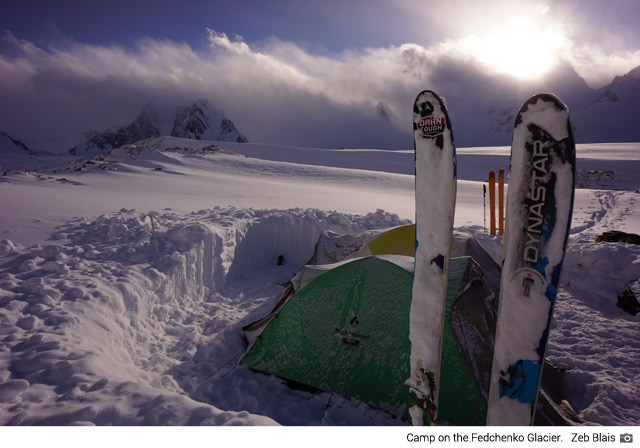

 Our extra days were spent regaining some of the pounds we lost during the expedition eating fresh tandoor bread, kebabs and local apricots and cherries. People greeted us everywhere and invited us to share bread and tea with them even if they couldn’t speak a word of English (and we could only muster hello and thank you in Tajik).
The team left Tajikistan with a good taste in our mouths in more ways than one. We explored and lived in a high mountain range for 29 days, were exposed to the kind and generous culture of the Tajik, Pamir and Afghan people and came home safe!
Thanks to the Eddie Bauer/ RMI Guide grant for assisting me in this amazing pursuit. The lessons I learned on this trip will forever shape my decision making and goals in the mountains. Until next time...
_________
Zeb Blais is a Senior Guide at RMI. He has climbed and skied mountains throughout North America. When he is not guiding, Zeb teaches avalanche courses and ski patrols at Squaw Valley in California. His spare time usually doesn’t save his feet from ski boots.
Our extra days were spent regaining some of the pounds we lost during the expedition eating fresh tandoor bread, kebabs and local apricots and cherries. People greeted us everywhere and invited us to share bread and tea with them even if they couldn’t speak a word of English (and we could only muster hello and thank you in Tajik).
The team left Tajikistan with a good taste in our mouths in more ways than one. We explored and lived in a high mountain range for 29 days, were exposed to the kind and generous culture of the Tajik, Pamir and Afghan people and came home safe!
Thanks to the Eddie Bauer/ RMI Guide grant for assisting me in this amazing pursuit. The lessons I learned on this trip will forever shape my decision making and goals in the mountains. Until next time...
_________
Zeb Blais is a Senior Guide at RMI. He has climbed and skied mountains throughout North America. When he is not guiding, Zeb teaches avalanche courses and ski patrols at Squaw Valley in California. His spare time usually doesn’t save his feet from ski boots.
Great Expedition!! Fantastic photos!
Posted by: Pamir Alpine Club on 3/30/2015 at 4:57 am
Posted by:
Categories: Mountaineering Fitness & Training
Very interesting, good job and thanks for sharing such a good blog. Your article is so convincing that I never stop myself to say something about it. You’re doing a great job. Keep it up
Posted by: Alisha Donnelley on 4/29/2018 at 7:40 am
Hi,
I signed up for a Mt. Rainier climb in September. The skills course - Muir.
I’ve been reading through the blog/emails that was forwarded to me. For the one above, you describe the run, and the four strength tests for testing your fitness, but you don’t give gauges of fitness levels (e.g. if you can do x pushups in 2 minutes, then you’re at y% of the goal, etc.)
Where can these be found? Otherwise, how do you know if you’re at, below or above the required fitness?
Thanks,
Steve
Posted by: Steve on 1/31/2013 at 6:39 pm
Posted by:
Categories: Everest BC Trek
 9. Lama Geshe: A renowned spiritual leader living in a small house in Pangboche, Lama Geshe never fails to greet visitors with a deep laugh and broad smile. As he chants prayers in his native Tibetan in a deep but soft voice, he provides a fascinating appreciation and insight into the Buddhist process of embarking on a journey, whether for an Everest Expedition or a trip to visit distant relatives.
 8. Momos: Akin to Chinese dumplings, the Nepalese momo is a delicious treat after a long day on the trail.
 7. Afternoon prayers at the Tengboche Monastery: After making the 1,300’ ascent to the ridge top Monastery, find a seat along the edges of the Dokhang (the prayer hall), framed by a two story tall golden statue of Buddha, and listen to the deep chants of the resident monks fill the space.
 6. Exploring Namche Bazaar: Perched on a hillside in the middle of the Khumbu, Namche Bazaar is the cultural and economic hub of this mountainous region. Yaks, monks, and Tibetan traders share the narrow streets with locals and trekkers alike, and a new discovery can be found around every corner, from tailors to bakeries to monasteries and museums.
 5. The experience of trekking lodge-to-lodge: After a warm breakfast served in a cozy dining room, shoulder a light day pack with only the gear you need for the day, leaving your duffel outside your door, and start up the trail. Spend the day wandering through villages, fields, and valleys, until you reach your next night's teahouse where your bag awaits. The teahouses are simple but comfortable, with cozy community dining rooms to eat, relax, and socialize in and sleeping rooms just down the hall.
 4. The Trail: While the excitement of trekking to Base Camp is reaching the foot of Everest at the end of the trail, the wonder comes from the entire experience of traveling the trail, where a simple centuries old footpath serves as both highway through the valley and the villages' Main Streets. Slow your pace now and again to look around and take in the shops, homes, and life that all happens right along the path!
 3. Island Peak's summit ridge: Ringed by several of the world's greatest mountains (Nuptse, Lhotse, Everest, and Ama Dablam), the airy summit ridge of Island Peak provides all of the excitement of Himalayan climbing in a short extension to the spring trek.
 2. Spending the night at Everest Base Camp: you've walked all that way, why turn around and leave again in a matter of hours? Spending the night in Base Camp is a peek into the full experience of embarking on an Everest Expedition and enjoying a cup of tea while watching the sun peak over the top of the Western Cwm is an unforgettable moment.
 1. Stopping to soak it all in: The Khumbu is simply an amazing place. One of the best things is just being there: stopping to dig your heels into the ground and looking around. There is nowhere else in the world like it.
 Ready to experience the Khumbu for yourself? Join RMI on a trek to Everest Base Camp!
Please see our in depth blog about hiking to everest base camp. We have pictures, our budget, planning, and pictures/videos. It should be very helpful for you!
http://www.ditchthemap.com/travel-blog/2016/4/15/14-day-everest-base-camp-trek-in-nepal
Posted by: Scott on 4/26/2016 at 11:30 pm
It is one of the best Everest Base Camp Trekking blog i have ever read. Really well written n knowledgeable thanks for sharing glad to read your blog.
Posted by: Everest Base Camp Trekking on 4/6/2015 at 12:26 am
Posted by:
Categories: Guide News


 With expeditions like this, the unknowns are bound to be many; I heard differing opinions on just about everything. “Kathmandu is modern and you can buy all your supplies there,” one person would say, and then the next day I would hear the opposite. For the record, Kathmandu is definitely not modern - but all this can be fun. I found adventure in the 21st century and that seems to be rare. So I planned for what I could and insulated myself from what I couldn’t. It was exhilarating to know that I had no concept of everything I’d face.
Near midnight on the 1st of September, I hit the tarmac of Kathmandu International Airport. The city of Kathmandu sits within a large valley at the foot of the Himalaya. Its streets are crowded and its buildings somewhat dilapidated, but the people are kind and the food is fantastic. Surely much has changed since the first westerners arrived, but there is still a sense of lore about the place. Hindu temples, large and small, are strewn about, and filled with worshipers while Buddhist monks’ roam the streets. The entirety of this scene is cast against the gear shops and bustle of everyday city life in a place steeped in climbing history.
With expeditions like this, the unknowns are bound to be many; I heard differing opinions on just about everything. “Kathmandu is modern and you can buy all your supplies there,” one person would say, and then the next day I would hear the opposite. For the record, Kathmandu is definitely not modern - but all this can be fun. I found adventure in the 21st century and that seems to be rare. So I planned for what I could and insulated myself from what I couldn’t. It was exhilarating to know that I had no concept of everything I’d face.
Near midnight on the 1st of September, I hit the tarmac of Kathmandu International Airport. The city of Kathmandu sits within a large valley at the foot of the Himalaya. Its streets are crowded and its buildings somewhat dilapidated, but the people are kind and the food is fantastic. Surely much has changed since the first westerners arrived, but there is still a sense of lore about the place. Hindu temples, large and small, are strewn about, and filled with worshipers while Buddhist monks’ roam the streets. The entirety of this scene is cast against the gear shops and bustle of everyday city life in a place steeped in climbing history.
 On September 10th I arrived at Chinese Base Camp, the “end of the road”. Over the previous week I’d driven through the alpine rainforests of Nepal and into the moonscape of the Tibetan Plateau. At the Tibetan border it is necessary to leave your Nepali ride and walk across the “Friendship Bridge” flanked on either side by the Nepalese and Chinese military. Once across, I met my Chinese Liaison and Tibetan driver. We quickly departed and speedily wove through the streets of Zhangmu, a border town perpetually stuck in a dense fog of clouds as they collide with the rising Tibetan Plateau. At Chinese Base Camp (BC, 16,300') I still was 2,400’ vertical feet and an unknown distance from Advanced Base Camp (ABC). I spent 3 days at BC waiting for yaks (pack animals that would move my supplies to ABC). While waiting, I developed a terribly bothersome head cold; unfortunately this was not the only time I got sick during this expedition. Days later and sick as a dog, I trekked the last distance into ABC, low visibility, snowing hard with a frigid wind in my face.
We erected ABC (18,700') and soon I fell into the rhythm of establishing higher camps mixed with days of leisure. Everything seemed to slowly come together, as I prepared my body and my supplies for a possible summit window in the beginning of October. I think what kept me most sane during the expedition was my focus on the immediate. An undertaking such as this can be daunting if you try to grasp the sum of the next 20-day span, including the challenges yet to be overcome. So I’d only spool out as much time as was immediately necessary in my mind, and kept my thoughts off the many days ahead of me to reach the summit.
Throughout the climbing period of the expedition I kept a brisk pace between camps, taking care not to push myself so hard that I couldn’t construct camp and take care of myself adequately afterwards. It’s a fine line up there; it’s far too easy to push yourself past the limit. I saw this countless times with other climbers but they had the safety net of Sherpas, guides, and teammates to assist them when they took on too much. I had no such safeguard and this was something I had to always take into account. I wouldn’t want to put a negative connotation on climbing solo though, because it was gratifying in its simplicity.
On September 30th I pulled into Camp 3 at 24,500’. I recall constructing camp atop a small ridge of snow perched beneath the notorious Yellow Band. Here I definitely felt the altitude. Beneath me two Sherpa friends were digging in a platform for their team’s arrival. I’d look over at them as I was catching my breath and they’d be doing the same, smiling and laughing with each other at the ridiculousness of it all.
Climbing without supplemental oxygen and solo (or as solo as it gets on Cho Oyu) has dangers that are heightened, namely the two forms of edema: HAPE and HACE. These affect the lungs and/or brain and are deadly if they persist without descending to lower altitudes. These conditions mainly strike during the night as your breathing naturally decreases. Being on your own when this happens can be mortally dangerous. I took measures to lower my risk by staying hydrated, well feed, comfortable, stress free, and I always kept a wary eye on my breathing and short term memory. The year prior I’d seen firsthand the grim realities of high altitude mountaineering on Argentina’s Aconcagua, after a rescue of another team turned tragic. Cerro Aconcagua was my previous high point at 22,841’. Everything beyond was unknown and I was well above that now and pushing higher. In hindsight, perhaps maybe I should have been more nervous at these altitudes, but I suppose I never felt threatened by them. As was the case in all my previous expeditions, the altitude only seemed to leave me breathless and nothing worse, not even a headache. And so I hydrated, ate and went to bed excited for my summit attempt only hours away.
On September 10th I arrived at Chinese Base Camp, the “end of the road”. Over the previous week I’d driven through the alpine rainforests of Nepal and into the moonscape of the Tibetan Plateau. At the Tibetan border it is necessary to leave your Nepali ride and walk across the “Friendship Bridge” flanked on either side by the Nepalese and Chinese military. Once across, I met my Chinese Liaison and Tibetan driver. We quickly departed and speedily wove through the streets of Zhangmu, a border town perpetually stuck in a dense fog of clouds as they collide with the rising Tibetan Plateau. At Chinese Base Camp (BC, 16,300') I still was 2,400’ vertical feet and an unknown distance from Advanced Base Camp (ABC). I spent 3 days at BC waiting for yaks (pack animals that would move my supplies to ABC). While waiting, I developed a terribly bothersome head cold; unfortunately this was not the only time I got sick during this expedition. Days later and sick as a dog, I trekked the last distance into ABC, low visibility, snowing hard with a frigid wind in my face.
We erected ABC (18,700') and soon I fell into the rhythm of establishing higher camps mixed with days of leisure. Everything seemed to slowly come together, as I prepared my body and my supplies for a possible summit window in the beginning of October. I think what kept me most sane during the expedition was my focus on the immediate. An undertaking such as this can be daunting if you try to grasp the sum of the next 20-day span, including the challenges yet to be overcome. So I’d only spool out as much time as was immediately necessary in my mind, and kept my thoughts off the many days ahead of me to reach the summit.
Throughout the climbing period of the expedition I kept a brisk pace between camps, taking care not to push myself so hard that I couldn’t construct camp and take care of myself adequately afterwards. It’s a fine line up there; it’s far too easy to push yourself past the limit. I saw this countless times with other climbers but they had the safety net of Sherpas, guides, and teammates to assist them when they took on too much. I had no such safeguard and this was something I had to always take into account. I wouldn’t want to put a negative connotation on climbing solo though, because it was gratifying in its simplicity.
On September 30th I pulled into Camp 3 at 24,500’. I recall constructing camp atop a small ridge of snow perched beneath the notorious Yellow Band. Here I definitely felt the altitude. Beneath me two Sherpa friends were digging in a platform for their team’s arrival. I’d look over at them as I was catching my breath and they’d be doing the same, smiling and laughing with each other at the ridiculousness of it all.
Climbing without supplemental oxygen and solo (or as solo as it gets on Cho Oyu) has dangers that are heightened, namely the two forms of edema: HAPE and HACE. These affect the lungs and/or brain and are deadly if they persist without descending to lower altitudes. These conditions mainly strike during the night as your breathing naturally decreases. Being on your own when this happens can be mortally dangerous. I took measures to lower my risk by staying hydrated, well feed, comfortable, stress free, and I always kept a wary eye on my breathing and short term memory. The year prior I’d seen firsthand the grim realities of high altitude mountaineering on Argentina’s Aconcagua, after a rescue of another team turned tragic. Cerro Aconcagua was my previous high point at 22,841’. Everything beyond was unknown and I was well above that now and pushing higher. In hindsight, perhaps maybe I should have been more nervous at these altitudes, but I suppose I never felt threatened by them. As was the case in all my previous expeditions, the altitude only seemed to leave me breathless and nothing worse, not even a headache. And so I hydrated, ate and went to bed excited for my summit attempt only hours away.


 Summit Day
I awoke at 12 midnight; outside I could hear guides addressing their climbers, the hiss of oxygen bottles as the regulators were spun on and the crunch of crampons engaging the firm snow as the first teams departed. Climbers’ torches faintly lighted my tent as they passed and the walls were lined with ice that rained down with the slightest nudge. I gave myself a once over, everything felt good and I was ready. I roused and started my stove, opened a few vents to ensure proper ventilation and stuck my head out the top of the tent. I had spoken to the leaders of the other expeditions and they were leaving quite early, at 12 midnight which meant they had woken up hours earlier. My plan was to leave as late as 2 am for two reasons: firstly I wanted to meet sunrise sooner as I would be running colder without O’s (oxygen), and secondly to give the other teams a large enough head start to ensure I could keep warm by continually climbing. But this night would be hapless from the moment I spilled my hot water all over the tent.
As the other teams passed, and in a moment of carelessness, I fumbled a liter of water in my tent. Luckily, everything required for the summit push was outside in my pack. But with the threat of getting my boots or down suit wet I decided to depart for the summit immediately. The time was 1 am, an hour earlier than I had planned, and as soon as I left my tent I saw a traffic jam forming at the Yellow Band – a formation of rock above Camp 3. Hoping that their supplemental oxygen would see them through with some speed I continued on, but as I ascended it became apparent that they would not climb as hastily as I had hoped. As I sat in line below this technical rock step my extremities lost feeling. Swinging them in circles - something we call “windmills”, easily reinvigorated my hands. But climbing through the chilly night, I wasn’t able to completely regain feeling in my toes, this was a constant concern. However, I had not lost the ability to wiggle them as I took each step so I continued climbing into the night.
Summit Day
I awoke at 12 midnight; outside I could hear guides addressing their climbers, the hiss of oxygen bottles as the regulators were spun on and the crunch of crampons engaging the firm snow as the first teams departed. Climbers’ torches faintly lighted my tent as they passed and the walls were lined with ice that rained down with the slightest nudge. I gave myself a once over, everything felt good and I was ready. I roused and started my stove, opened a few vents to ensure proper ventilation and stuck my head out the top of the tent. I had spoken to the leaders of the other expeditions and they were leaving quite early, at 12 midnight which meant they had woken up hours earlier. My plan was to leave as late as 2 am for two reasons: firstly I wanted to meet sunrise sooner as I would be running colder without O’s (oxygen), and secondly to give the other teams a large enough head start to ensure I could keep warm by continually climbing. But this night would be hapless from the moment I spilled my hot water all over the tent.
As the other teams passed, and in a moment of carelessness, I fumbled a liter of water in my tent. Luckily, everything required for the summit push was outside in my pack. But with the threat of getting my boots or down suit wet I decided to depart for the summit immediately. The time was 1 am, an hour earlier than I had planned, and as soon as I left my tent I saw a traffic jam forming at the Yellow Band – a formation of rock above Camp 3. Hoping that their supplemental oxygen would see them through with some speed I continued on, but as I ascended it became apparent that they would not climb as hastily as I had hoped. As I sat in line below this technical rock step my extremities lost feeling. Swinging them in circles - something we call “windmills”, easily reinvigorated my hands. But climbing through the chilly night, I wasn’t able to completely regain feeling in my toes, this was a constant concern. However, I had not lost the ability to wiggle them as I took each step so I continued climbing into the night.
 After the Yellow Band, I threaded my way through a steeper section comprised of rock and snow, unclipping from the fixed lines and passing other teams as often as I was able too. The process of passing other teams at that altitude is quite tiring, as I had to abandon my efficient rhythm for a faster pace outside of the beaten in route, at times breaking into the snow up to my knees. Luckily I only had to do this 3 or 4 times as the majority of the climbers were moving faster than I was, with their bottled oxygen giving them more stamina. I recall one moment at 25,800' when I became exceedingly nauseous. But it quickly passed and I continued on. This was the only moment I felt the altitude affect me.
At Camp 3, when I left, it was warm and still with high clouds touching the summit, but now, at 26,000', a light wind had picked up and the last of the high clouds were blowing over me. My suit was covered in ice and I had to stop periodically to rewarm my face by burying it in the cowl of my hood. As I reached striking distance of the summit (or so I thought) the horizon became faintly lit. And I encouraged by what it signified!
As I came over the top onto the summit plateau I saw a high point off to my left, but Liz Hawley, an elderly woman who keeps the records of the Himalaya, warned me against this. I met Liz in Kathmandu, and discussed my plan for the expedition. She instructed me, “When you enter the plateau you’ll see a high point off to your left that seems to be the obvious summit, but go forward and slightly to your right and continue until you see Everest. This will be the true summit.” I recalled her words and continued on straight. Those last 45 minutes plodding along at 26,900' for what seemed an eternity, a quarter of a mile, the summit not even visible (or so I thought) was the hardest for me. I had nothing to hold onto. The plateau seemed to stretch beyond the visible horizon. Despair mounted at the thought of having to start grid searching for the damnable thing. I scanned the plateau again. It was then that I noticed a single string of prayer flags off in the distance to my right; on a mound no higher than 3 feet from the point I was standing. It was the summit, maybe one of the least climactic summits I’ve experienced, but I was deeply relieved when I got there and found myself standing at the summit of Cho Oyu!
Alex Barber on the summit of Cho Oyu
I was on top for about 15 minutes. Most of the time seated on my pack eating peanut M&Ms and washing them down with warm Tang from my thermos. I made a speedy descent to Camp 3, quickly packed and made the entire descent to ABC, arriving soon after dusk. Dawa, one of my cooks waited outside of ABC for me with hot tea and a huge smile, after a celebratory embrace we descended the last 15 minutes together into ABC. I felt relieved to be finished. The day was October 1st, I had summited at 8:20 am that morning Nepali time.
You know, I’ve been asked what it felt like for everything to culminate and be on top. That feeling of accomplishment or exhilaration - what was it like? But I think what draws me isn’t that singular moment at the top or any feeling of exhilaration from being there. Instead it’s the quieter and constant sense of contentment that comes from the simplicity of mountaineering, the journey along the way and being surrounded by extraordinary beauty that challenges you to conquer – not the mountain – but yourself. For me the journey is the destination.
After the Yellow Band, I threaded my way through a steeper section comprised of rock and snow, unclipping from the fixed lines and passing other teams as often as I was able too. The process of passing other teams at that altitude is quite tiring, as I had to abandon my efficient rhythm for a faster pace outside of the beaten in route, at times breaking into the snow up to my knees. Luckily I only had to do this 3 or 4 times as the majority of the climbers were moving faster than I was, with their bottled oxygen giving them more stamina. I recall one moment at 25,800' when I became exceedingly nauseous. But it quickly passed and I continued on. This was the only moment I felt the altitude affect me.
At Camp 3, when I left, it was warm and still with high clouds touching the summit, but now, at 26,000', a light wind had picked up and the last of the high clouds were blowing over me. My suit was covered in ice and I had to stop periodically to rewarm my face by burying it in the cowl of my hood. As I reached striking distance of the summit (or so I thought) the horizon became faintly lit. And I encouraged by what it signified!
As I came over the top onto the summit plateau I saw a high point off to my left, but Liz Hawley, an elderly woman who keeps the records of the Himalaya, warned me against this. I met Liz in Kathmandu, and discussed my plan for the expedition. She instructed me, “When you enter the plateau you’ll see a high point off to your left that seems to be the obvious summit, but go forward and slightly to your right and continue until you see Everest. This will be the true summit.” I recalled her words and continued on straight. Those last 45 minutes plodding along at 26,900' for what seemed an eternity, a quarter of a mile, the summit not even visible (or so I thought) was the hardest for me. I had nothing to hold onto. The plateau seemed to stretch beyond the visible horizon. Despair mounted at the thought of having to start grid searching for the damnable thing. I scanned the plateau again. It was then that I noticed a single string of prayer flags off in the distance to my right; on a mound no higher than 3 feet from the point I was standing. It was the summit, maybe one of the least climactic summits I’ve experienced, but I was deeply relieved when I got there and found myself standing at the summit of Cho Oyu!
Alex Barber on the summit of Cho Oyu
I was on top for about 15 minutes. Most of the time seated on my pack eating peanut M&Ms and washing them down with warm Tang from my thermos. I made a speedy descent to Camp 3, quickly packed and made the entire descent to ABC, arriving soon after dusk. Dawa, one of my cooks waited outside of ABC for me with hot tea and a huge smile, after a celebratory embrace we descended the last 15 minutes together into ABC. I felt relieved to be finished. The day was October 1st, I had summited at 8:20 am that morning Nepali time.
You know, I’ve been asked what it felt like for everything to culminate and be on top. That feeling of accomplishment or exhilaration - what was it like? But I think what draws me isn’t that singular moment at the top or any feeling of exhilaration from being there. Instead it’s the quieter and constant sense of contentment that comes from the simplicity of mountaineering, the journey along the way and being surrounded by extraordinary beauty that challenges you to conquer – not the mountain – but yourself. For me the journey is the destination.
 Alex Barber is a mountain guide for RMI Expeditions and splits his time between the beaches of Southern California and mountains around the world. Alex will be guiding an Expedition Skills Seminar – Winter in January before returning to the Himalaya this spring to attempt Lohtse and Shishapangma. Read more about his climb and follow the upcoming adventures on www.alexanderbarber.com.
Congratulations Alex!
Posted by: Jen and Nick Boekenoogen on 11/26/2013 at 9:53 am
Alex - I am so impressed and proud of you! What an extraordinary journey and story. But I guess I should expect nothing less from you as you are an extraordinary young man. You are so often on my mind. God’s peace to you my friend - and hope to see you again this summer on the Emmons. Linn Perkins
Posted by: Linn Perkins on 11/16/2013 at 9:07 am
Posted by:
Categories: Mountaineering Fitness & Training
| DAY | WORKOUT | TOTAL TIME | DIFFICULTY |
| 1 | Rainier Dozen / Easy Hiking ( 30 min) | 42 min. | Medium |
| 2 | Rainier Dozen / High Intensity Stair Interval Training (60 min) | 72 min. | Very Hard |
| 3 | Rainier Dozen / Rest | 12 min. | Recovery |
| 4 | Strength Circuit Training x 4 | 54 min. | Hard |
| 5 | Rainier Dozen / Rest | 12 min. | Recovery |
| 6 | Fitness Test | 60 min. | Medium |
| 7 | Rainier Dozen / Hike (4 hrs, 15lbs of pack weight) | 252 min. | Medium |
| Total | 8 hrs 24 mins |
What is a realistic pack weight from base to camp Muir and from Muir to summit?
Thank you
Posted by: Mark on 11/26/2019 at 8:58 am
I am climbing Rainier in mid May 2018 and plan to utilize the 16 week training plan starting first week in January. Where can I find the plan online? or can I begin getting these emails to start in Jan 2018? thanks john
Posted by: John Gay on 11/17/2017 at 11:56 am
Posted by: Elias de Andres Martos
Categories: Guide News


Congrat’s Elias and Bridgette!
Posted by: Ryan Aldrich on 12/16/2011 at 7:38 am
Posted by: Luke Wilhelm, David Price
Categories: Expedition Dispatches Aconcagua
It is good to be back in the summer heat of Mendoza! The team returned to the city healthy, safe, and proud of our climbing accomplishments. Switching our boots and jackets for flip flops and swim suits has been a welcomed change. To unwind from the trip, we have enjoyed all of what the city has to offer. Lounging by the pool and eating copious amounts of gelato have been our main focuses. The group has become incredibly close during our time in Argentina. We are all eager to head home, yet reluctant to part ways. As the trip concludes, we will continue to relish in each others company until the final moments. Our time together has truly been the best.
Till next time,
RMI Guide Luke Wilhelm, David Price and Team
Posted by:
Categories: Mountaineering Fitness & Training
| DAY | WORKOUT | TOTAL TIME | DIFFICULTY |
| 1 | Rainier Dozen / Easy Hiking ( 30 min) | 42 min. | Medium |
| 2 | Rainier Dozen / Stair Interval Training (50 min) | 62 min. | Hard |
| 3 | Rainier Dozen / Rest | 12 min. | Recovery |
| 4 | Rainier Dozen / Strength Circuit Training x 3 | 46 min. | Hard |
| 5 | Rainier Dozen / Rest | 12 min. | Recovery |
| 6 | Rainier Dozen / Cross Training (1 hr) | 72 min. | Hard |
| 7 | Rainier Dozen / Hike (3 hrs) | 192 min. | Medium |
| Total | 6 hrs 18 mins |


To the top we go! Thirteen days into our trip, we can all feel the wear and tear from the previous mountains. Chimborazo is our final objective, the tallest of the three peaks standing tall at 20,500'.
There is quietness to the team as we get ready for our climb. As per usual, the alarm clock goes off far too early. There is no need to go wake folks since we are all sleeping in a dome tent. An hour goes by quickly and we are all roped up ready for our journey. The first portion of the route has a disappointment clever feel as we traverse under el castillo. Crampons and rocks is never a fan favorite but the team cruises through it. A short section of ice brings us to our first break. No matter how tired the team may be, everyone looked motivated to keep going. From that moment to the summit we climbed sustained steep switchbacks. The climb is unrelenting, never easing up. After a few false summits and a confusing bright star we reached the lower summit Pico Veintimilla. Once at the false summit we make the extra 30 minute walk to the true tippy top. A very faint glow of the sunrise greets us at the top.
The team finishes their trip three for three on the volcanos. The hardwork and preparation they all put in for these climbs shows with the great success on all the volcanos. Its a bitter sweet moment on top as we celebrate our victory but also acknowledge that this trip is coming to an end. After snapping summit photos and the beauty of the sun rising, we safely reverse our steps and head back down to camp. We pack up our things, enjoy some pizza and coffee and then make our way back to the van. The van has never looked so good. We free our feet from the confines of our mountaineering boots and load up. After a hard days climb we all look forward to hot showers, comfy beds, and celebratory drinks.
Moods are high as we reminisce on our climbs. With heavy eyes from an early start, its early to bed for all. Its been a great day and an excellent trip. We can all go to sleep feeling good about all that we have accomplished. Tomorrow we make our way back to Quito and then back to the states.
Goodnight all,
RMI Guides Adam Knoff, Hannah Smith, and team
Congrats to all!! 2022 is bringing great things! Safe travels home
Posted by: Jane on 2/21/2022 at 2:28 pm
Wonderful. What a thrill…..
Posted by: Terri L. Jennings on 2/21/2022 at 6:56 am




hey
Posted by: natalie on 4/27/2018 at 9:03 am
It was rally useful for me. I am going to improve the level of my mountaineering with the use of this methods.
Posted by: hossein bakhtiarzadeh on 2/27/2014 at 9:02 pm
View All Comments