RMI Guides Andres Marin and Katie Bono spent a week leading RMI's Alaska Alpine Skills Seminar this spring. After the seminar they returned to the Alaska Range for a personal climbing trip. Andres Marin: I guided the Alpine and Expedition seminars in Alaska, where our teams had an incredible time climbing and learning. When the seminars ended, I had a few days to spend climbing around Base Camp.
Katie Bono: Both Andres and I had time at the end of our trip for some personal climbing. We bid adieu to our team in Talkeetna and the next morning flew back into Kahiltna Base Camp.
Kahiltna Base Camp sits in the heart of the Alaska Range, surrounded on all sides by peaks such as Denali, Mt. Foraker, and Mt. Hunter. With the plethora of climbing options the pair decided to climb the Kahiltna Queen (12,380’).AM: Around Base Camp there are so many cool peaks to climb and one of those is the rarely climbed Kahiltna Queen. This peak is located at the end of the southeast fork of the Kahiltna glacier. It is the only peak in the range that divides three different glaciers: the Kahiltna, the Ruth and the Tokositna.
KB: Andres and I spent a day skiing up the Southeast fork of the Kahiltna Glacier, stopping along the way to look at different climbing options and to do some ice climbing. Kahiltna Queen looked like a gorgeous peak to climb and both of us were stoked about trying an unclimbed route.
The following night Katie and Andres began their climb up the West side of the Kahiltna Queen. KB: The line we took followed a rib splitting the west face, starting from where the rib emerged from the glacier. The part of the climb was mostly steep snow climbing on some great and not-so-great neve (granular snow that accumulates near mountain tops from wind and precipitation). The route then transitions into ice climbing with some rock mixed in.
AM: The mixed climbing was great all the way to the summit. The day was incredible and the views were just amazing. At the top we stopped to melt water and high five. Then it was time for us to start descending the West Couloir Route. The descent ended up being longer and more difficult than I expected as we had to do over fourteen rappels.
Following the successful climb, Katie and Andres, skied two hours back to Base Camp. After 25 hours of climbing they returned safely to Base Camp.KB: Seeing the moonrise while we were climbing was awesome! It came up for maybe an hour or so and just skimmed the edge of the horizon. For the whole way up we had splitter weather and were basking in the sun at the summit. After this trip I can definitely understand why my friends are excited about Alaska. It was great to be able to climb the Kahiltna Queen after guiding the Alaska Seminar since it enabled me to spend so much time in the Alaska Range. Andres has heaps of experience in the Alaska Range and I learned a lot from working and climbing with him.
AM: All and all it was a great climb with a great partner. I am already looking forward to next year’s seminar and more personal climbs in the Alaska Range.
Andres Marin is a senior guide at RMI leading programs in Washington, Alaska and Colorado. He is an off-width specialist and an accomplished ice and mixed climber. One of his recent achievements includes climbing the five hardest mixed lines in Ouray, Colorado, in a day. Andres is a fully certified alpine and rock guide sponsored by Millet, Blue Water Ropes, 5.10, Petzl, GU and Ice Holdz.
Katie Bono is an RMI Guide and accomplished climber with impressive ascents in North America and Canada. A retired Nordic ski racer and Millet athlete, she currently holds the women’s speed record on Mt. Rainier.
To see more of their climb check out Andres’ Kahiltna Queen video.
Do you think the Kahiltna Queen can be solo’d in January? There is a climber in Talkeetna, Alaska right now who may attempt the first solo of the KQ in January 2019. He was going to solo Denali, but due to the government shut-down, that was a no-go. Alaska just had a big earthquake (7.0) on November 30, 2018, and the aftershooks are still plentiful even in Big Lake and Talkeetna, which are not that far from KQ. I wish this climber the best and would value your opinion.
Posted by: Annie G on 1/12/2019 at 4:13 am
Anyone looking into Andres’ background as a guide or a teammate can have confidence that he is capable of more than most and still patient with those less skilled. (thanks again, Andres)
Posted by: Creighton Miller on 8/15/2013 at 8:15 pm
How do you utilize rest breaks in your training and climbs? Do you take a break to eat? And another when you are thirsty? Perhaps when your legs get tired and uncomfortable? A quick bathroom break on the side of the trail? It's important to take care of all of these needs but they need to approached strategically to prevent rest breaks from turning an otherwise long endeavor into an epic. Learning to manage your rest breaks and keep them efficient makes a big difference on summit day.
At RMI, the oft-used cliché is that we take "maintenance breaks," not rest breaks. Consider all of the needs that need to be taken care of mid-climb: you need to relieve yourself, take in enough calories to maintain your energy output, hydrate, adjust your clothing layers to changing conditions, perhaps take care of a hot spot so that it doesn’t become a debilitating blister, get a few minutes off of your feet, and just maybe snap a couple of photos. This list can easily turn into a half an hour of tasks, even if each only took just 4-5 minutes to accomplish. After thirty minutes your legs will likely start to stiffen and your temperature start to drop, not to mention that a few half-hour breaks together can turn a 10 hour day into a 12+ hour day in the mountains, stretching the limits of how long we can climb safely and maintain our focus.
The moral of the story is that efficiency is key: we want to try to take care of all of our needs in the span of ten minutes to leave a few minutes to relax before getting back on the trail and making progress towards the finish line. Ultra marathoners do this with "walking breaks," slowing to a walk every hour to make sure that their body is primed for the next hour. Mountainous terrain doesn’t let us take breaks on the fly, but the principle remains the same. Taking short, deliberate, and consistent breaks keeps us climbing strongly throughout the day. Making rest breaks efficient takes practice. Learn to multitask in your breaks: take a couple bites of food while you shuffle clothing layers, relieve yourself before you sit down to start your other chores, and sip on water throughout the break. As you get better at it, you’ll find that you’ve taken care of everything in the first few minutes, and you can relax and let your legs get a bit of recovery for the rest of the break.
No matter how efficient you are, the time rest breaks take add up. Taking efficient breaks too frequently can drain just as much time as taking a couple of long breaks. In the mountains, we try to maintain a consistent pace for an hour or so before stopping for ten to fifteen minutes to refuel and take care of ourselves. This proves to be an effective interval for our bodies in terms of replenishing depleted stores yet still allows us to reach our destination. Practice this interval in your training too and by your next climb it will feel like second nature.
Questions? Comments? Share your thoughts here on the RMI Blog!
The Five Day Climb June 3 - 7, 2021 is completing their climb today. The teams did training at Paradise on Friday with instruction on cramponing, rope travel and ice axe arrest. On Saturday they made the ascent from Paradise to Camp Muir. Yesterday, they enjoyed some additional time walking in crampons and working as a rope team by walking to Ingraham Flats at 11,200'. This allowed them to see abit of the route in the day light hours. They planned their summit attempt for today but unfortuaty the team was unable to make a summit attempt due to high winds. According to the Camp Muir Telemetry wind averages were 34 - 53 mph with gusts up to 68 mph.
The teams will descend from Camp Muir to Paradise and make the drive back to Ashford. We look forward to seeing them at Rainier BaseCamp later today.
Strong winds overnight kept the teams at Camp Muir. Telemetry shows wind gusts in the 50-60 mph range. RMI Guide Henry Coppolillo reported a nice morning at Camp Muir as the wind continued to decrease. Around 7 am, the teams were going to ascend to Ingraham Flats to explore the terrain above Camp Muir and enjoy the sunshine. The teams will return to Camp Muir, pack their gear and descend to Paradise later this morning.
46 years ago, August 24, 1967, I began my first summit climb of Mt. Rainier. I was a paying customer. The cost was $25, which included a One-Day Climbing School. Nevertheless, as many have, I contacted the Guide Service (it wasn’t RMI yet) and pleaded my case to avoid the training and lessen the price. I pointed out I had backpacked earlier in the summer and encountered snow, which I successfully negotiated. Alas, the manager informed me I needed the Climbing School, but proposed I carry a load of food to Camp Muir to work out the cost. Terrific! John Anderson drew a rudimentary map of the ‘route’ to Muir one Saturday morning at Paradise in early July and my only question was “how many round trips?” (I was totally serious). His deadpan reply was that one ought to do it. My trip to Muir is another story for another time. I managed to deliver the supplies and participated in Climbing School the following day.
The evening of August 23, 1967, some neighbors from Lakewood dropped me off at Paradise. My folks had provided money for a hot dog at the snack bar, but a room in the Inn was out of the question. Not a problem, so I headed to the Inn to kill the evening before finding a suitable campsite. Employee Talent Shows were a nightly occurrence at Paradise Inn in the good old days. The hotel management hired people oftentimes based primarily on musical or other talent. At the conclusion of the show a juke box was cranked up, and employees and guests alike hit the dance floor for a couple of hours. I was content to watch. At 10:00PM I donned my waiting pack (a wooden frame Trapper Nelson) and walked up the Skyline Trail a short distance above Paradise Inn. There I settled in beneath a cluster of sub-alpine fir and spent the night.
Dawn on Saturday, August 24th, promised a perfect day for the trek to Camp Muir. Guide Service headquarters was located in the basement of the Visitor Center (the flying saucer) and there I met the other clients and our two guides, Tony Andersen and John Rutter. There were five clients, including myself. I can’t remember details about the trip to Muir, other than I positioned myself in line directly behind the ‘cabin girl’ headed up to cook for the guides. There was no client Bunkhouse, instead the guides on each trip would pitch and strike White Stag car-camping tents (the guides headquartered in the tiny, rock Cook Shack). Dinner was provided as part of the fee: beef stew & mashed potatoes (from #10 cans), as well as breakfast when we awoke to climb (#10 can peaches). Even a sleeping bag was supplied (I had no concern of when it may have been cleaned last).
Summit day took 12 hours round trip: nine hours up and three hours down. There were three ladders to cross on the Ingraham Glacier. We left Muir at midnight and about half-way across the Cowlitz Glacier, I realized I’d left my gloves in camp. No big deal; I would tough it out. On a side note, it goes without saying we weren’t wearing helmets, beacons, harnesses or headlamp (we carried flashlights), or even gaiters. I wore wool army pants, my ‘parka’ was a Navy pea coat (heavy wool), and we were tied directly into the 150’ goldline rope with a bowline on a coil or bowline on a bight.
Above the first rest break, we negotiated the ladders and traversed north onto Disappointment Cleaver. My hands were pretty damn cold (the guides hadn’t noticed my predicament) as we ascended the spine of the Cleaver. On top of DC we took our second rest break and lo and behold, one person decided to call it quits. Before resuming the ascent I screwed up my courage and asked the person staying behind if I could by any chance borrow his gloves… of course I could!
High on the summit dome I was really starting to run out of gas, and we were still more than an hour from the crater. Could I/Should I drop out?! John Rutter’s emphatic answer was a resounding NO! I kept plugging. Now the rim was in sight, and slowly getting closer. But then… what the hell?! Instead of halting for a much needed break we didn’t so much as pause, traversed through the rocks, dropped into the crater and crossed. Sign the book. Un-tie and reach Columbia Crest. Hero shot. The weather was perfect. It was 9:00AM, Sunday, August 25, 1967.
Occasionally over the years I have wondered if I blocked our descent from memory; was it that much an ordeal?! I recall very little, other than being incredibly thirsty. In retrospect, we took some wrong turns on the DC (Disappointment Cleaver), which necessitated backtracking uphill (killer). At Muir we were plied with Kool-Aid. The descent to Paradise took forever, but at the parking lot I was one happy, exhausted 16-year-old.
I didn’t play organized sports in high school; I grew up with parents who hated camping (but enjoyed road trips and appreciated National Parks); to suggest I wasn’t particularly studious is a gross understatement; but I had just discovered something I loved, that would stay with me for the rest of my life: climbing. Over the next winter I bothered Lou incessantly about becoming an Apprentice Guide (I even applied for work at Paradise Inn, but evidently lacked a requisite talent). At some point (maybe just to put me off), Lou and/or John Anderson said to show up at Paradise in June, and see if there was work. I did; there was; and, there still is!
RMI Guide Joe HoriskeyPhoto Captions:
August 25th, 1967 - Joe Horiskey, age 16, on the Mt. Rainier summit. Mt. St. Helens, pre-1980 eruption, in the background.
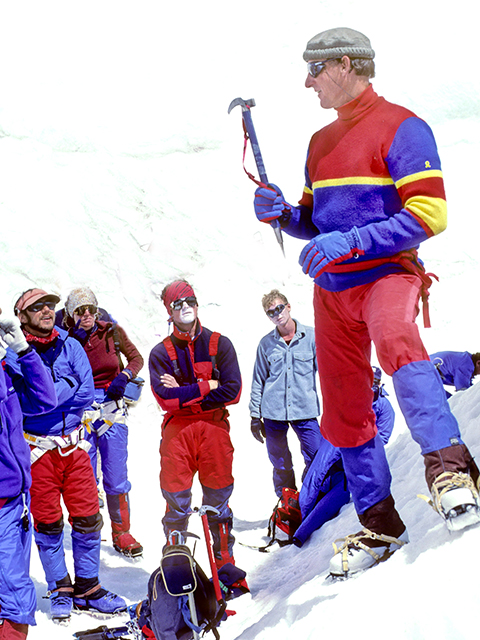
1968 - Jim Whittaker, Joe Horiskey, and Lou Whittaker on Mt. Rainier. Joe's first year working for the guide service, which became RMI the following year.
Summited with Joe as the lead guide on a July 1980 trip. I was the anchor on his rope team and wrote about the climb for The Daily World in Aberdeen. I remember that the southeast flanks of the mountain below 13,000 feet were covered in ash from Mount St. Helens eruptions. At our rest stop above DC, Joe gave us a pep talk about some dicey crevasses that awaited us. He said, “Let’s just grab the bull by the horns and go.”
Posted by: John Dodge on 8/14/2024 at 3:26 pm
Great story, thank you for telling us about it. I loved the part when you said “lo and behold someone decided to call it quits after passing through the DC”.This part was where three of my team members last year decided to turn around too ( and I will admit I was about ready to also if guide Bridgette B. hadn’t coached me through my anxiety). RMI has great guides that put their lives in jeopardy so people can achieve their personal goal of reaching the summit. Thank you so much! And Joe, congrats and a high-five for your very first summit at age sixteen!
Posted by: Stephanie Antich on 7/20/2015 at 12:03 am
The Four Day Climb Teams led by RMI Guides Dustin Wittmier and Matias Francis turned at 12,000' on Mt. Rainier today. Dustin reported high winds of 60 mph on the upper mountain that forced the teams to turn before reaching the summit. The team climbed safely back to Camp Muir and plan to depart at 11 am today. They will reach Paradise in the early afternoon.
Our team enjoyed a rest day at Camp 2 (ABC) today. Their plan is to head for Camp 3 tomorrow.
This really is the start of the Mt. Everest summit push in my eyes. How the next two days go, can have real impact on the summit day.
It is so hard to try and maintain strength at these higher camps that you better hope the internal battery is charged, you will be drawing off of your reserves for sure. The team is focusing on eating and hydrating, keeping their bodies strong and ready. Four of our climbing Sherpa left Base Camp today and joined the climbers at ABC. Everyone is doing well and looking forward to the next few days.
RMI Guide Dave Hahn is one of the best mountain guides in the business. With many expeditions under his belt, he knows how to climb this mountain. The weather forecast still looks promising. Good luck to the team!
RMI Guide Mark Tucker
RMI Guide Dave Hahn checks in from ABC on a rest day.
When most people think about strength workouts, they think about joining a gym and lifting weights to build muscle mass. I grew up as an alpine ski racer and continue to stay involved in the sport now as a ski coach. If you have watched an alpine ski race, in person or on TV, you know that ski racing is all about leg strength. Although mountaineers don’t need to be hitting the weight room to the same extent as a ski racer, strength is a key component to climbing.
Traveling around the world as an athlete, coach, and guide, I do not always have access to a weight room. During the season I still need to do exercises to maintain strength. I make use of local parks or playgrounds (where the entry fee is free) or even my own living room.
Below are a couple of key exercises that you can do either in a gym or in the comfort of your own home. Remember, whenever doing strength workouts, it is important to get a proper warm-up and cool-down and listen to your body in order to stay injury-free and get the most from the workout.
Warm-Up: This involves 15 - 20 minutes of running or biking to get your muscles warmed up. This is imperative since diving into strength training cold is a great way to hurt yourself. This time can be spent on a stationary bicycle, a couple laps around the neighborhood on a road bike or mountain bike, a few laps around the track or soccer field, or a jog around the neighborhood.
Body Weight Squats: Start your workout with two legged squats, feet hip width apart, with no weight. As you up your training, adding weight is a viable option as long as your form and technique stay correct. Jugs of water, rocks, or chunks of firewood all make good weight additions. To maintain form and avoid injury, make sure that your knees are stacked over your ankles. Start with doing three sets of 10 reps. I usually go down for a count of 2 - 3 seconds and up for the same count.
One-Legged Squats: These are my personal favorite; still a leg strength building exercise, one-legged squats also add a balance component. In order to protect your knees during any squats, I recommend going no deeper than a 90-degree bend in the knee (doing these in front of a mirror when you first start can be beneficial). Start out with the non-weight bearing leg parallel to the standing leg. As you master this, play around with the position of the leg in the air. It can be in front, out to the side, or back. Now not only are you working on leg strength but you are also working on balance. Work up to 3 reps of 10 on each leg. Depending on your baseline strength you may start with 2 reps of 5 on each leg and then slowly work up.
Again as this gets easier for you, add weights in your hand or try these on grass or sand. All of this will change your balance and the difficulty.
Wall-Sits: Simply sit against a wall with your knees bent at a 90 degree angle like you are sitting in an invisible chair with your back and butt against the wall. This is a real thigh burner. Start by holding this for 30 seconds to a minute and doing two or three sets, shaking your legs out in between. As you get better at this, increase the time you are holding to up to a few minutes. Another way to increase the difficulty is to hold an object straight in front of you, such as a ski boot or climbing boot.
Lunges: With an emphasis on quad-strengthening exercises it is important to incorporate some hamstring-strengthening exercises as well. One suggestion is lunges. The key to these is that they are done slowly; you are building strength as you lower your body weight and raise it again. Make sure that your knees are lined up above your ankles and feet, and do not push your knee beyond your toes. I usually start with my hands on my hips doing 2 to 3 sets of 10 - 15 lunges on each side (20 - 30 total in a set), and alternate which leg is in front. Again, as this becomes easier for you, you can add free weights.
Pull-Ups: These are nice because they can be done anywhere. Not only is it good arm strength exercise, but it also involves the core. Pull-ups can be done with a pull-up or chin-up bar in your house, or at the local playground on the monkey bars. Start out with 2 sets of five. If this is hard for you, have someone hold your knees to assist you after doing a few on your own. You will be amazed how much you will improve just by trying them on your own and then going through the motion with someone assisting you.
Cool-Down: In order to aid recovery for the following days, do a proper cool-down. Spend another 15 minutes on a bike or finish with a light jog to get out some of the lactic acid. Don’t forget that stretching is also an important aspect of the cool-down process.
Listen to your body with any workout. All of the recommendations of sets are exactly that - recommendations; do what makes sense for you. Depending on your starting point you may have to start with fewer and work up. That is okay; continue to work on strength exercises and you will see improvements. Set benchmarks and goals for yourself so that you can see the improvements! Often times the process of seeing yourself improve is all the motivation you need!
______
Lindsay Mann is a senior guide at RMI Expeditions and a NCAA D1 Skiing Champion. She has climbed and guided around the world, from Peru to Alaska. Lindsay is leading a team of female climbers to scale Mt. Rainier on a special Four Day Summit Climb next summer, August 12 - 15, 2014.
Questions? Comments? Share your thoughts here on the RMI Blog!
The Four Day Climb July 4 - 7 led by RMI Guides Dustin Wittmier and Josh McDowell led their teams to the summit of Mt. Rainier today. The guides reported windy conditions on the mountain but an overall clear and sunny day. They are currently at Camp Muir and will pack and ready for the remainder of their descent to Paradise.




 Kahiltna Base Camp sits in the heart of the Alaska Range, surrounded on all sides by peaks such as Denali, Mt. Foraker, and Mt. Hunter. With the plethora of climbing options the pair decided to climb the Kahiltna Queen (12,380’).
AM: Around Base Camp there are so many cool peaks to climb and one of those is the rarely climbed Kahiltna Queen. This peak is located at the end of the southeast fork of the Kahiltna glacier. It is the only peak in the range that divides three different glaciers: the Kahiltna, the Ruth and the Tokositna.
KB: Andres and I spent a day skiing up the Southeast fork of the Kahiltna Glacier, stopping along the way to look at different climbing options and to do some ice climbing. Kahiltna Queen looked like a gorgeous peak to climb and both of us were stoked about trying an unclimbed route.
Kahiltna Base Camp sits in the heart of the Alaska Range, surrounded on all sides by peaks such as Denali, Mt. Foraker, and Mt. Hunter. With the plethora of climbing options the pair decided to climb the Kahiltna Queen (12,380’).
AM: Around Base Camp there are so many cool peaks to climb and one of those is the rarely climbed Kahiltna Queen. This peak is located at the end of the southeast fork of the Kahiltna glacier. It is the only peak in the range that divides three different glaciers: the Kahiltna, the Ruth and the Tokositna.
KB: Andres and I spent a day skiing up the Southeast fork of the Kahiltna Glacier, stopping along the way to look at different climbing options and to do some ice climbing. Kahiltna Queen looked like a gorgeous peak to climb and both of us were stoked about trying an unclimbed route.

 The following night Katie and Andres began their climb up the West side of the Kahiltna Queen.
KB: The line we took followed a rib splitting the west face, starting from where the rib emerged from the glacier. The part of the climb was mostly steep snow climbing on some great and not-so-great neve (granular snow that accumulates near mountain tops from wind and precipitation). The route then transitions into ice climbing with some rock mixed in.
AM: The mixed climbing was great all the way to the summit. The day was incredible and the views were just amazing. At the top we stopped to melt water and high five. Then it was time for us to start descending the West Couloir Route. The descent ended up being longer and more difficult than I expected as we had to do over fourteen rappels.
The following night Katie and Andres began their climb up the West side of the Kahiltna Queen.
KB: The line we took followed a rib splitting the west face, starting from where the rib emerged from the glacier. The part of the climb was mostly steep snow climbing on some great and not-so-great neve (granular snow that accumulates near mountain tops from wind and precipitation). The route then transitions into ice climbing with some rock mixed in.
AM: The mixed climbing was great all the way to the summit. The day was incredible and the views were just amazing. At the top we stopped to melt water and high five. Then it was time for us to start descending the West Couloir Route. The descent ended up being longer and more difficult than I expected as we had to do over fourteen rappels.
 Following the successful climb, Katie and Andres, skied two hours back to Base Camp. After 25 hours of climbing they returned safely to Base Camp.
KB: Seeing the moonrise while we were climbing was awesome! It came up for maybe an hour or so and just skimmed the edge of the horizon. For the whole way up we had splitter weather and were basking in the sun at the summit. After this trip I can definitely understand why my friends are excited about Alaska. It was great to be able to climb the Kahiltna Queen after guiding the Alaska Seminar since it enabled me to spend so much time in the Alaska Range. Andres has heaps of experience in the Alaska Range and I learned a lot from working and climbing with him.
AM: All and all it was a great climb with a great partner. I am already looking forward to next year’s seminar and more personal climbs in the Alaska Range.
Andres Marin is a senior guide at RMI leading programs in Washington, Alaska and Colorado. He is an off-width specialist and an accomplished ice and mixed climber. One of his recent achievements includes climbing the five hardest mixed lines in Ouray, Colorado, in a day. Andres is a fully certified alpine and rock guide sponsored by Millet, Blue Water Ropes, 5.10, Petzl, GU and Ice Holdz.
Katie Bono is an RMI Guide and accomplished climber with impressive ascents in North America and Canada. A retired Nordic ski racer and Millet athlete, she currently holds the women’s speed record on Mt. Rainier.
To see more of their climb check out Andres’ Kahiltna Queen video.
Following the successful climb, Katie and Andres, skied two hours back to Base Camp. After 25 hours of climbing they returned safely to Base Camp.
KB: Seeing the moonrise while we were climbing was awesome! It came up for maybe an hour or so and just skimmed the edge of the horizon. For the whole way up we had splitter weather and were basking in the sun at the summit. After this trip I can definitely understand why my friends are excited about Alaska. It was great to be able to climb the Kahiltna Queen after guiding the Alaska Seminar since it enabled me to spend so much time in the Alaska Range. Andres has heaps of experience in the Alaska Range and I learned a lot from working and climbing with him.
AM: All and all it was a great climb with a great partner. I am already looking forward to next year’s seminar and more personal climbs in the Alaska Range.
Andres Marin is a senior guide at RMI leading programs in Washington, Alaska and Colorado. He is an off-width specialist and an accomplished ice and mixed climber. One of his recent achievements includes climbing the five hardest mixed lines in Ouray, Colorado, in a day. Andres is a fully certified alpine and rock guide sponsored by Millet, Blue Water Ropes, 5.10, Petzl, GU and Ice Holdz.
Katie Bono is an RMI Guide and accomplished climber with impressive ascents in North America and Canada. A retired Nordic ski racer and Millet athlete, she currently holds the women’s speed record on Mt. Rainier.
To see more of their climb check out Andres’ Kahiltna Queen video.




Do you think the Kahiltna Queen can be solo’d in January? There is a climber in Talkeetna, Alaska right now who may attempt the first solo of the KQ in January 2019. He was going to solo Denali, but due to the government shut-down, that was a no-go. Alaska just had a big earthquake (7.0) on November 30, 2018, and the aftershooks are still plentiful even in Big Lake and Talkeetna, which are not that far from KQ. I wish this climber the best and would value your opinion.
Posted by: Annie G on 1/12/2019 at 4:13 am
Anyone looking into Andres’ background as a guide or a teammate can have confidence that he is capable of more than most and still patient with those less skilled. (thanks again, Andres)
Posted by: Creighton Miller on 8/15/2013 at 8:15 pm
View All Comments